A Simple Truth Most Investors Miss
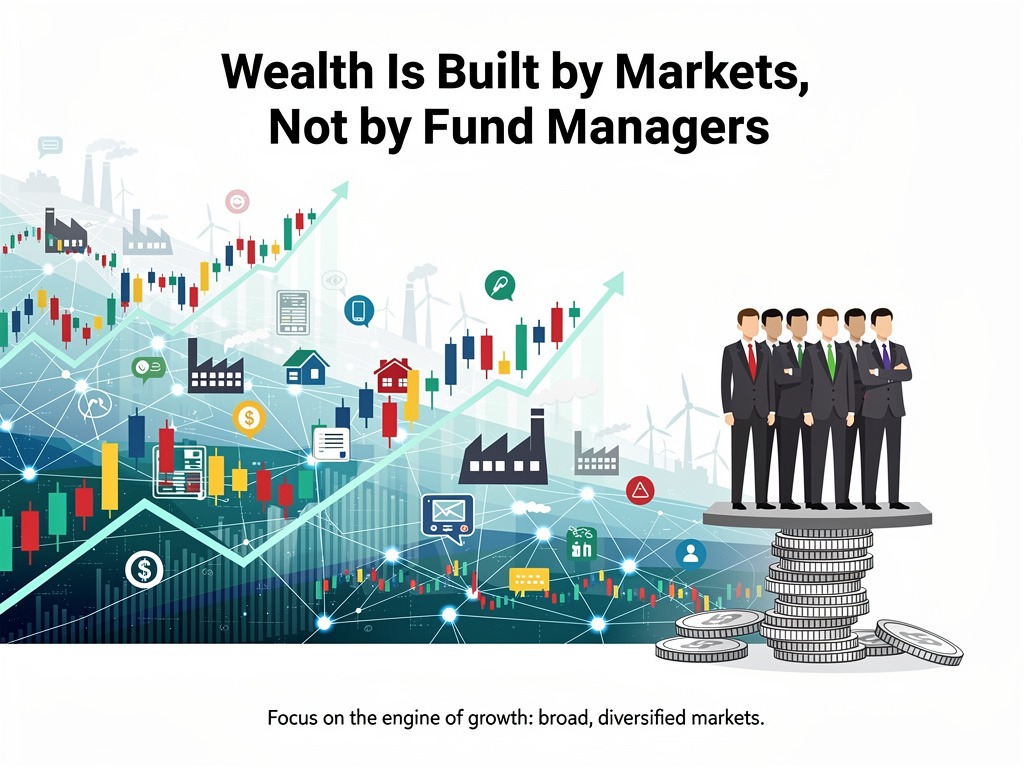
Wealth is not created by fund managers.
It is created by businesses and markets.
Yet many investors spend years searching for the “right” fund manager, believing skill alone will deliver superior returns. The data tells a very different story.
According to the SPIVA India 2024 report, nearly 85 percent of actively managed funds underperform their benchmark indices over the long term. Betting on manager selection is not a strategy. It is speculation.
Why Active Fund Picking Often Fails
Active funds face multiple structural challenges:
- Higher expense ratios
- Portfolio churn and timing errors
- Behavioral biases during market stress
Even experienced managers struggle to consistently outperform a broad market index after costs.
If your large-cap fund has delivered less than approximately 19 percent over the last five years, or your mid- and small-cap fund less than around 31 percent, it has failed to beat its respective index.
The conclusion is clear. Outperformance is rare, unpredictable, and difficult to sustain.
Index Investing: Where Simplicity Wins
Index investing is built on a powerful idea: instead of trying to beat the market, own the market.
When you invest through index funds or ETFs:
- You automatically match market performance
- You eliminate fund manager risk
- You minimize costs and tracking errors
- You improve the probability of long-term success
Index investing removes complexity and replaces it with discipline.
What Returns Should Investors Realistically Expect?
Chasing unrealistic returns often leads to poor decisions. Long-term wealth is built by aligning expectations with reality.
Historically reasonable benchmarks are:
- Large-cap equities: approximately 13 to 14 percent
- Mid and small-cap equities: approximately 17 percent
Trying to consistently exceed these numbers through active bets increases risk without reliably improving outcomes.
Ignore the Noise, Follow the Data
Successful investing is not about reacting to headlines or market emotions. It is about following signals supported by evidence.
Smart investors:
- Resist emotional decision-making
- Avoid chasing recent performers
- Rely on long-term data and structure
Clarity consistently beats complexity in building sustainable wealth.
Getting the Best of Both Worlds: Core and Satellite Strategy
Pure passive investing offers stability, but strategic flexibility still has value. The solution lies in a core-satellite portfolio approach.
Core Portfolio (70 Percent)
The foundation of your portfolio should be built on:
- Index funds and ETFs
- Broad market exposure
- Low cost and high transparency
This core delivers consistency and market-linked growth.
Satellite Portfolio (30 Percent)
The satellite layer is where active insight can add value through:
- Sectoral opportunities
- Thematic funds
- High-conviction equity positions
These exposures should be guided by research, valuation discipline, and risk management.
Why This Approach Works
The core-satellite structure offers:
- The reliability of index investing
- The potential for selective outperformance
- Controlled risk without overdependence on fund managers
It combines market participation with strategic opportunity.
Simplicity Is the Ultimate Sophistication
Investing success does not come from complexity or constant action. It comes from discipline, cost control, and staying invested in productive assets.
Markets create wealth. Businesses generate returns. Investors who respect this reality build lasting portfolios.
The most powerful strategy is often the simplest one, executed consistently.